A QR digital menu is the restaurant’s menu opened in the phone’s browser when a code is scanned. No other app is needed. In Spain the usual decision is not a single program: a free plan, a page on your own website or a paid platform do different jobs. Here I compare what each route publishes on price, limits and where the menu stays, with the pages consulted on 24 September 2026.
The QR digital menu opens the menu on the phone, with nothing to install
A QR digital menu has to do three things: open when it is scanned, be readable on the phone and let you change a price without reprinting the room. The code is not the menu. The code points to an address, and the menu is what is at that address.
Those three tasks are split across three routes, and it is worth naming them before looking at prices:
- The free plan is a QR menu tool with a 0 € fee. The customer scans and sees the menu on that tool’s domain, with the cap the plan publishes (dishes, photos, changes or your own address).
- Your own menu is a page on your website. The QR opens your domain. You update it where you update the rest of the venue.
- The paid platform is software with a fee. It can be the menu only, or the menu inside a POS. The menu lives in its system.
A PDF behind a QR is also “free” if you already have the file. On the phone it forces you to zoom and it is not a page of the venue. Why the menu works better as a page, and not as a PDF, is in what makes a restaurant website successful. This guide stays on the three routes.
The free plan, your own menu and the platform do not cost the same
The free plan publishes 0 € and leaves the menu in the tool, with a limit. The platform publishes a monthly or annual fee and it is still its system. Your own menu has no fee from a menu tool: the cost is the website that hosts it.
| Route | What it is | What it publishes on price (24 Sep 2026) | Where the menu stays | When it fits |
|---|---|---|---|---|
| Free plan | A QR menu tool with a plan at 0 €. | BuenaCarta: “0€ forever”, unlimited dishes; photos and your own URL, paid. Scan Carta: 0 € up to 20 dishes and one change a month. CartaDigitalQR: Básica plan “FREE” and “Forever”; orders from the menu, not available. | On the tool’s domain. | A short menu, a single venue, and you are fine editing inside its cap. |
| Paid platform | Menu software, or a menu inside a POS. | BuenaCarta: 8,95 € and 12,95 €/mes + VAT (Spain). Scan Carta: 15 €/mes or 120 €/año. CartaDigitalQR: 7,90 € and 14,90 €/año. Qamarero: QR menu included from 119 €/mes, with the POS. | In its system. BuenaCarta reserves your own URL for the paid plan. | Someone who wants photos, languages, orders, or the POS price and the table price to be the same. |
| Your own menu | A menu page on your domain. | No fee from a menu platform. At GastroSEO it sits in the Professional Website plan: 1.490 €, one-off payment. | On your website. The QR opens your address. | The menu has to live with the booking, the listing and the venue’s text. |
Sources, consulted on 24 September 2026: buenacarta.com/tarifas.html, scancarta.com, cartadigitalqr.es/tarifas, qamarero.com/carta-digital and qamarero.com/precios. The price of the website that hosts your own menu, if GastroSEO builds it, is further down and is that of the Professional Website plan.
The short reading: 0 € is the tool’s fee, not the domain or the text. A platform’s fee pays for its system. Your own page pays for the website once and the QR stops pointing at another brand.
The free plan publishes 0 € and leaves the menu on its domain
The free plan exists, and the limit is not the same on every page. On BuenaCarta, consulted on 24 September 2026, the Gratuito plan says “0€ forever” and includes a digital menu, access by QR, logo and a photo of the venue, allergens and unlimited dishes. The same page leaves for the paid plan your own URL, import from Excel, photographs of the dishes and removing the advertising. Its FAQ answers that the free plan has no time limit and no hidden costs.
Scan Carta, the same day, publishes another 0 € figure with another cap: “Free digital menu for life up to 20 dishes” and “One change a month”. It is not the same product as an unlimited menu. If the menu goes past twenty dishes, or the price changes more than once a month, that free plan no longer covers what it advertises.
CartaDigitalQR labels the Básica plan as “FREE” and “Forever”. On that plan its own table says orders from the menu are not available. The paid plan is the one that adds ordering.
In all three cases the QR is printed once and a dish change is made in the tool, not on paper, while you stay inside its cap and the address does not change. What they do not give you at 0 €, on the pages that separate it this way, is the menu on your domain, photos of the dishes or changes with no quota.
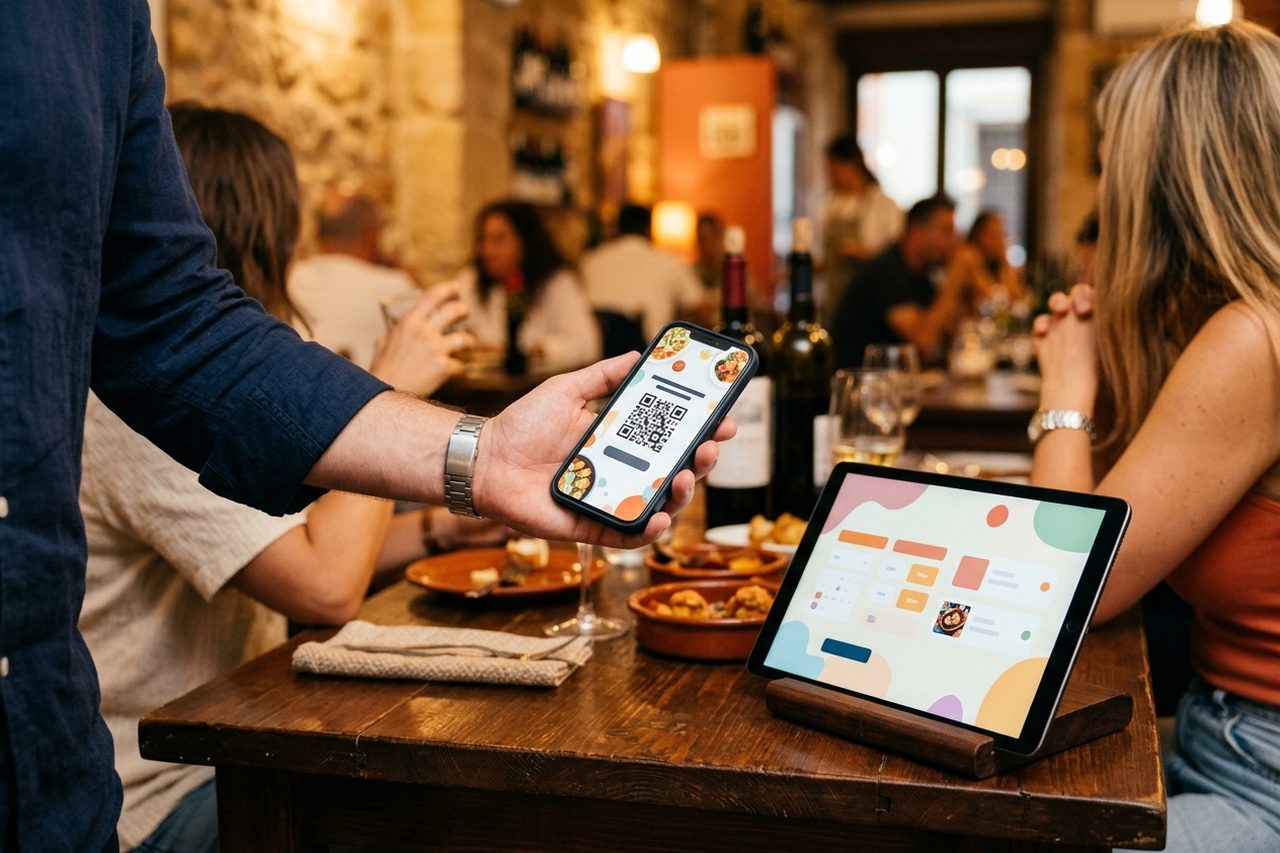
The paid platform charges a fee and the menu stays in its system
The paid platform is the same family of tools, or a POS that includes the menu, with a published amount. It is not “the digital menu” in the abstract: each page charges for a different thing.
BuenaCarta, on the Spain tariff consulted on 24 September 2026, asks 8,95 €/mes for the Avanzado plan (what the free plan has, plus your own URL, Excel, dish photos and no advertising) and 12,95 €/mes for Premium (plus automatic translation, phone support, hours per menu and embedding the menu). VAT is not included: the page says “21% VAT not included” and that those prices are Spain’s. Having them enter the dishes for you costs 79 € + VAT, and it is included if you contract Premium. There is no lock-in. You cancel and the service continues until the period already paid ends.
Scan Carta publishes 15 € a month, or 120 € a year, for custom design, a booking button, no advertising, phone support and unlimited changes. CartaDigitalQR shows Avanzada at 7,90 €/año and Profesional at 14,90 €/año, with no lock-in, with a 15-day trial and no payment details. That page has an “Excluding VAT / Including VAT” selector and does not say, next to the figure, which of the two was active: here the amount the page returned is cited, not a closed price with or without tax. Its FAQ adds a nuance the others do not have: the initial installation can ask for basic knowledge of web servers. It is not only signing up on someone else’s website.
Qamarero does not sell the menu on its own at the price of those fees. On its digital-menu page, the same day, it writes “Included from 119€/mes” and “On every plan”. The menu is the POS seen from the customer’s phone: a change of dish, price or sold-out status on the POS is reflected at the tables, with the 14 allergens of mandatory declaration, automatic translation into English, French and Italian, and a QR per table. No app is needed. The pricing page is titled “Plans from 119€/mes” and says that all of them include POS, order handheld, QR menu, kitchen screen and order-and-pay from the table. The Total plan is listed at 249 €/mes. The Pack Duo (Basic plus another module) is listed at 199 €/mes. There is no lock-in. The specific amount of the Basic plan was not in the body of that page: the “from 119 €/mes” is the floor they publish, not a tariff we have filled in.
They are four products. A fee of less than 15 € a month pays for a menu. 119 € a month, at Qamarero, pays for floor software that has the menu inside it. Comparing only the first number mixes the two things.
Your own menu is a page on your domain
Your own menu is a page on your website, and the QR opens that page. There is no BuenaCarta, Scan Carta, CartaDigitalQR or Qamarero fee for the menu. The cost is having the website. The customer sees your domain in the browser bar, the same place where the address is and, if there is one, the booking.
That changes three things the free plan leaves out or charges for separately. The address is yours: if you leave the tool, you do not have to reprint the room to point at another brand, because the code already pointed at your place. The photos and the allergens live on the same page as the rest of the venue, not on a higher plan. And a dish can be linked from the home page or from a neighbourhood page, which is what a menu hosted on another domain does not do.
At GastroSEO that menu, dynamic and with filters and allergens, sits in the Professional Website plan: 1.490 €, one-off payment. The price of a platform, if you still contract one, does not sit inside those 1.490 €: you agree it with that provider. The booking button is another piece, on the same website; how to compare it is in online bookings for restaurants.
The QR does not write the dish names. A line that says the product, the origin and the cooking reads better than an empty adjective, on the paper menu and on the digital one. If you want us to write them, the work is gastronomic copywriting.
Each venue fits a different menu
The right route is the one that covers the gap that is failing you today: not paying a fee, not reprinting every week, or not having the menu on a domain that is not yours.
A bar with a short menu can live with the free plan
If you fit inside the published cap — twenty dishes and one change a month on Scan Carta, or unlimited dishes with no photos and no URL of your own on BuenaCarta’s free plan — the fee is 0 €. The real cost is the time spent loading the dishes and the fact that the customer opens another brand. When the menu of the day changes daily, that cap falls short.
Someone who already has a POS and wants a single price fits a floor platform
That is where software of the Qamarero type fits: the menu the table sees is the POS menu, from 119 €/mes according to its page, with the rest of the system inside. A menu-only tool (8,95 €, 12,95 € or 15 € a month, or an annual tariff of less than 15 €) does not replace the POS. It replaces the PDF.
The restaurant already searched for by name needs the menu on its website
If the customer comes in through your domain, a QR that sends them to another tool takes them off the page where they were going to book. Your own menu leaves the menu, the booking button and the address in the same place. The free plan still works as a trial; it stops working when the menu is part of the website and not a loose link.
A group asks for the same menu, with the price of that layer in writing
Several venues multiply the platform fee and, at Qamarero, the pricing page sets groups aside on a plan with bespoke conditions: the amount is not in the table. On your own website the menu is one page per venue, or a single page if the menu is the same. The price of that website is the plan’s, not a fee per QR.
Four mistakes when setting up the QR menu
The expensive failures are treating the 0 € plan as unlimited, reprinting the code when only a price changes, sending to another brand someone who was already on your website, and publishing allergens nobody has checked:
- Treating 0 € as unlimited. BuenaCarta separates photos and your own URL from the free plan. Scan Carta cuts off at 20 dishes and one change a month. “Free forever” is the phrase on its page, not a menu with no cap.
- Reprinting the QR when a price changes. The code points to an address. The dish is changed on the menu. The QR paper is reprinted when the address changes, not when a dish’s price changes.
- Taking off your website the customer who had already found you. The QR on the table and the one on the Google listing have to open the same menu as the website. If one opens a platform and the other a PDF, the customer does not know which is up to date.
- Marking allergens without looking at the recipe. BuenaCarta, Qamarero and CartaDigitalQR publish that the menu can flag allergens, Qamarero the 14 of mandatory declaration dish by dish. You load the data. The tool does not taste the dish.
On the website, the menu sits in the Professional Website plan
At GastroSEO the dynamic digital menu, with filters and allergens, sits in the Professional Website plan: 1.490 €, one-off payment. The QR opens a page on your domain, on the same website as the booking, so the customer does not jump brand between the menu and the table. The account with a menu platform, if you contract one, is yours with that provider: it does not sit inside the 1.490 €.
The dish texts, if you do not want to leave them as the bare product name, are gastronomic copywriting. The full website system is in the reference article, the booking in online bookings for restaurants, and the brand, SEO and website work, in the restaurant marketing agency. To see the plan with the published price, go to web design for restaurants.
Frequently asked questions
What is a QR digital menu?
It is the restaurant’s menu opened in the phone’s browser when a code is scanned, with no app to install. It is what BuenaCarta, Scan Carta, CartaDigitalQR and Qamarero describe on the pages consulted on 24 September 2026. The code points to an address: if it is a platform’s, the menu lives there; if it is a page on your domain, the menu is yours.
Is there a digital menu that is really free?
Yes, on the plans that publish 0 €. BuenaCarta advertises “0€ forever” with unlimited dishes, allergens, logo and QR, and leaves the photos and your own URL on the plans at 8,95 € and 12,95 €/mes, plus VAT, Spain prices. Scan Carta advertises 0 € up to 20 dishes and one change a month. CartaDigitalQR labels Básica as “FREE” and “Forever”, and on that plan orders from the menu are not available. Free is the tool’s fee, not the writing of the menu or the restaurant’s domain.
What is the difference between a platform and your own menu?
The platform stores the menu in its system and, if the plan is not the free one, charges the fee it publishes. Your own menu is a page on your website: the QR opens your domain. At GastroSEO that dynamic menu, with filters and allergens, sits in the Professional Website plan, 1.490 € one-off payment. The platform fee, if you contract it, does not sit inside those 1.490 €.
How much does a QR menu platform cost?
There is no single price. On 24 September 2026, BuenaCarta publishes 8,95 €/mes (Avanzado) and 12,95 €/mes (Premium), plus VAT, in Spain, with no lock-in. Scan Carta publishes 15 € a month or 120 € a year. CartaDigitalQR shows 7,90 €/año and 14,90 €/año, with no lock-in; the page has a VAT selector and the figure is the one it was showing, with no “VAT included” written beside it. Qamarero includes the QR menu from 119 €/mes inside software that is also a POS, and publishes the Total plan at 249 €/mes, with no lock-in. A menu on its own and a POS are not compared by the first euro.
Do I have to reprint the QR when I change a price?
No, if the code points to an address and the change is made on that menu. BuenaCarta gives you a code to download and print, and the dish is edited on the menu. Qamarero publishes that a price change on the POS is seen instantly at the tables. The code has to be reprinted when the address it points to changes, not when a dish’s price changes.
Does a PDF with a QR code count as a digital menu?
It is a file behind a code. On the phone you have to zoom and it is not a page on your website. The difference between the menu as a page and the menu in PDF is in what makes a restaurant website successful.
Does the GastroSEO website include the digital menu?
On the Professional Website plan, 1.490 € one-off payment, the digital menu is dynamic, with filters and allergens, inside the website. The dish texts are a separate job: gastronomic copywriting. The published plan is in web design for restaurants.
Who loads the allergens on the menu?
You, or whoever transcribes the recipe. BuenaCarta includes allergens on the free plan. Qamarero publishes the 14 of mandatory declaration, dish by dish. CartaDigitalQR advertises allergen information on each dish. None of those pages says it checks the kitchen: they show what has been written.