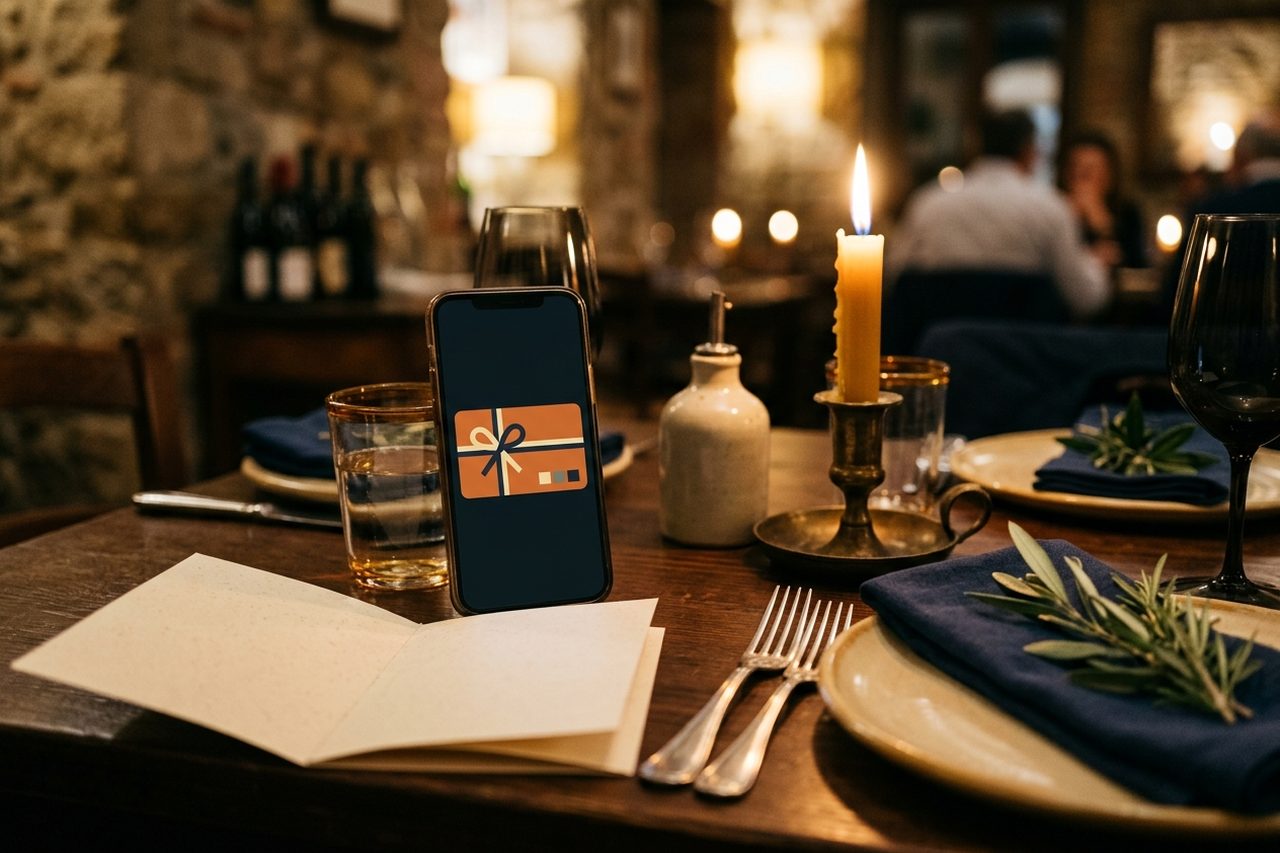
A restaurant gift voucher is an amount, or a tasting menu, paid on the website and redeemed later in the venue. The buyer chooses the value or the menu, pays, and receives a code or a PDF. The restaurant does not send the food on the day of the purchase. Whoever wants to give the gift finds it on the venue’s own website or on a marketplace that gathers several restaurants. This page compares those two routes with a third one those listings do not explain: the payment link. GastroSEO is the studio that builds the shop where the restaurant sells the voucher, with one-off plans of 1.790 €, 2.990 € and 3.990 €. The example pages were read on 24 September 2026.
The SERP of 12 September 2026 sells the gift and does not explain how to set it up
The Google Spain SERP archived on 12 September 2026 (DataForSEO, google.es, desktop) for “tarjeta regalo restaurante” (320 searches a month) and “menú degustación regalo” (90) brings an AI Overview and People Also Ask, with no local pack. The top 10 are the restaurant’s own shop listings and marketplaces. There is no guide on how to sell the voucher. On 24 September 2026 the API did not respond: those two figures have not been measured again.
The gift card works when it is paid on the website and a code is redeemed
The gift card works when the buyer pays before sitting down and the venue recognises a code on the day of the visit. It has to do three things: charge the amount, hand over a code the restaurant can recognise, and say, before payment, how it is redeemed. No stock and no shipping are required. Whoever receives the gift has to know which restaurant it is valid for, until when, and whether they have to book.
Those three jobs are split across three routes, and it is worth naming them before looking at prices:
- The payment link is a checkout page, of the Stripe Payment Links type. You fix an amount, share the link on the website, by WhatsApp or as a QR, and the money lands in your account. There is no catalogue.
- Your own shop is a product on your domain. It can be a fixed-amount card or a tasting menu with a name, a price and conditions. The customer buys where your menu already is.
- The marketplace is someone else’s website. Restaurantia or Wonderbox publish experiences and vouchers. Whoever gives the gift buys there, not at your place.
If the frame is the venue’s website (menu, booking and when it makes sense to charge), it is in what makes a restaurant website work. This guide stays on the voucher and on the menu that is given as a gift.
The payment link, your own shop and the marketplace do not cost the same
The payment link charges the gateway commission on each sale and has no shop fee. Your own shop adds that commission, or its gateway’s, to the platform fee and to the work of building the catalogue. The marketplace publishes the price the customer sees on its website and does not publish, on the pages below, what percentage it keeps.
| Route | What it is | What it publishes on price (24 Sep 2026) | Where it is bought | When it fits |
|---|---|---|---|---|
| Payment link (Stripe Payment Links) | A payment page with no shop. The link is shared, also as a QR or a button. | Included in the standard rate, with no extra charge for the link. 1,5 % + 0,25 € on standard cards from the European Economic Area; 2,8 % + 0,25 € on premium cards from the same area. The pricing page opens with “Sin comisiones mensuales, ocultas ni de configuración”. | On Stripe’s page. The money lands in your account. | One or a few fixed amounts, sent from the website or by WhatsApp. |
| Your own shop (Shopify, gift card or menu listing) | A product on your domain: several amounts or a named menu. | The help centre does not charge a fee for the card. You set the amount, greater than zero and up to 10.000 USD or the equivalent, and at least one is required. The customer does not type a free amount in the shop. At GastroSEO the shop is 1.790 €, 2.990 € or 3.990 €, one-off. | On your domain. The code is created when the order is completed. | Several amounts, a named tasting menu, or more than one venue. |
| Marketplace | Another website lists the experience or a voucher so the recipient can choose. | Restaurantia shows experience prices in its listing (50 €, 149 €) and writes “directamente sin intermediarios”, with no commission in euros. Wonderbox advertises vouchers from 10 € to 500 € on its site. | On the marketplace domain. | When you want to appear in a catalogue that does not carry your name. |
Sources, consulted on 24 September 2026: stripe.com/es/pricing, stripe.com/es/payments/payment-links, Shopify help centre on gift cards, restaurantia.com and wonderbox.es, restaurant and gastronomy gift cards. The shop price, if GastroSEO builds it, is below and is the online-shop plan price. Stripe’s international-card block that day shows 2,5 % + 0,25 € and 3,15 % + 0,25 €; the page does not leave, in the text that was read, which of the two figures matches each card type.
The short reading: the link charges the sale and does not organise a catalogue. The shop charges the sale and leaves the menu on your domain. The marketplace shows the gift to someone who was not looking for you, and the purchase does not go through your website.
A Payment Link sells a fixed amount without opening a shop
A payment link sells a fixed-amount voucher with no catalogue and no monthly shop fee. Stripe describes it, on the Payment Links page consulted on 24 September 2026, as a payment page created with no code and with no need for a website. The same link is shared with many customers, by email, by SMS or by another channel, and it can become a QR code or a button. It accepts a one-off payment, a recurring payment or a custom amount.
On the pricing page, the same day, Payment Links “se incluye sin ningún otro cargo para las empresas con tarifas de pago estándar”. The card rate that page labels is 1,5 % + 0,25 € for standard cards from the European Economic Area and 2,8 % + 0,25 € for premium cards from that area. At the top it writes: “Sin comisiones mensuales, ocultas ni de configuración.” Using your own domain in the link URL is optional and is listed at 10,00 US$.
That covers the 50 € voucher, the 100 € voucher or a dinner deposit, sent from the website or by WhatsApp. It does not cover a listing with a photo, a six-step menu broken down and a delivery email in your brand: the customer pays on a Stripe page. If later the voucher sits next to bottles, packs or several venues, the link falls short and a catalogue is needed. The commission, compared with other gateways, is in payment gateways for restaurants.
Your own shop leaves the amount or the menu on your domain
Your own shop is a product of your website, and the customer pays without leaving your brand. Shopify, in the help centre consulted on 24 September 2026, treats the gift card as a digital product. The amount is called a denomination: any amount greater than zero, up to a maximum of 10.000 USD or the equivalent in your currency, a cap the page says cannot be raised. At least one denomination is required. The customer cannot type an amount of their own in the shop: if they want another value, the help-centre text says to create a draft order, charge the invoice and then issue the card. When the order is completed, Shopify creates the card and lists it in the admin, with its code.
That is different from a loose link. The shop can hold several amounts (30 €, 50 €, 100 €) or a product that is not a round number: the tasting menu for two, with what it includes and how it is booked. The table on shopify.com/es/precios, the same day, includes the row “Vende tarjetas de regalo”. Shopify’s monthly fee is not repeated here: the page the query returned was in dollars, and the euro figure we use is the one already published, with its date, on the gastronomic online shop.
Whoever already sells the gift on their own website publishes concrete things, not a programme. Papagena, consulted on 24 September 2026, offers a voucher for two with a six-step menu and shows 120 € next to the small print: it is used in a single visit, valid for 12 months from purchase, prices include VAT, advance booking subject to availability, and it cannot be exchanged for money or stacked with other promotions. 7 Portes, the same day, offers a card “a medida de su presupuesto” and, beside it, two experiences for two people (Caja Tasta’m and Menú del Chef), with no amount in euros on that page. Grupo Dani García has a shop category with one card per restaurant (Leña, Tragabuches, Lobito de Mar, Bibo and the rest), also with no euros on the category page. Los Quesos de L’Amélie sell a tasting-menu voucher for two, with six options from 63 € to 96 €, valid for 6 months from purchase, and they warn that the terrace is booked by phone and the dining room does not take bookings.
The gifted tasting menu, on those listings, is not an empty amount. It is a product with covers, steps or boards, a price and a booking rule. The closed amount (50 €, 100 €) is the other listing: whoever receives it orders what they want until the balance runs out. Both can live in the same shop. Redemption, when the day comes, needs a table: how it is booked is in online bookings for restaurants.
The card is obtained on the restaurant’s website or on a marketplace
The gift card is obtained on the restaurant’s own page or on a marketplace that lists several venues. No extra directory is needed: the buyer opens the listing, chooses an amount or a menu and pays. The marketplace is someone else’s catalogue, and the purchase does not go through your domain. Restaurantia, consulted on 24 September 2026, heads its listing with “Comprar y regalar experiencias gastronómicas en establecimientos singulares directamente sin intermediarios”. That listing has prices of specific experiences: 50 €, 75 €, 70 €, 160 €, 57 €, 60 €, 80 €, 149 € and 108 €, among other listings. There is not, on that page, a commission in euros or as a percentage that the restaurant pays to appear. Regala Restaurantes, the same day, in its Madrid selection, lists menus and cards with a “desde” price: Zalacaín from 190 €, Pabú from 180 € and Perretxico from 33 €, among others. Wonderbox advertises a voucher with an amount to choose between 10 € and 500 €, redeemable for experiences in its catalogue (stay, gastronomy, wellness, adventure), and multi-brand cards of 20 €, 50 €, 75 € and 100 €. Those three purchases happen on their site, not on the restaurant’s.
Those pages do a discovery job: the customer arrives looking for a gift, not for your venue’s name. What they do not do, in the text that was consulted, is leave the listing on your domain or say what share of the price reaches you. If a salesperson proposes a percentage, the number has to be in the contract. We do not treat it as published here because those pages do not publish it.
Whoever already searches for you by name does not need that catalogue in order to buy. If the only place the voucher lives is the marketplace, that visit leaves. Your website listing and the marketplace listing can coexist: one for whoever has already chosen you, the other for whoever does not yet know your name.
Validity, booking and cash redemption are written before payment
The voucher listing has to say, before you charge, how long it lasts, whether a booking is required and whether it can be exchanged for money. It is not a design detail. It is what the buyer accepts.
The Dirección General de Consumo of the Junta de Andalucía, in a note of 5 January 2025, writes that issued vouchers, and the gift card, cannot have an expiry date, and it calls that practice illegal. The same note talks about purchase returns and, for distance purchases, the right to withdraw within 14 calendar days except for the exceptions in the law. This article is not advice: it is what that department published. Beside it, the listings reread on 24 September 2026 still print a term. Papagena writes 12 months. Los Quesos de L’Amélie write 6 months. Both put it on the same page as the price, together with the booking and, at Papagena, the “no canjeable por dinero”.
The term you choose is checked by your adviser against that note and against the text that applies to you. What the website can settle is that the condition is read before the pay button, not in a later email, and that the floor knows what it committed to serve. Shopify lets you set an expiry date on the card and change it later, even if it has already expired: the help centre consulted on 24 September 2026 says so. That the software lets you type a date does not say whether that date fits what the consumer authority has published.
Each venue fits a different door
The right route is the one that covers the gap that fails you today: charging an amount without building a shop, explaining a named menu, or appearing in a catalogue that is not yours.
A single amount can live on a payment link
If the gift is a figure (50 €, 100 €) and someone can write the code in the book or at the till, the Payment Link is enough. The commission is Stripe’s, with no monthly fee on the pricing page. When three amounts, a photo and an email in your brand appear, the link stays on Stripe’s page and the catalogue asks for a shop.
The named tasting menu fits a listing on your website
A product fits there: how many people it is for, what it includes, what it costs and how it is booked. That is what Papagena publishes (120 €, six-step menu, two people) and L’Amélie (six menus, from 63 € to 96 €). An empty amount does not say whether the gift is the dinner or a balance for the menu.
A group needs one card per venue, in the same shop
Grupo Dani García publishes a different card per restaurant, inside one category. The customer chooses the venue before paying. A single link, with one amount and without the restaurant’s name, does not do that job. The shop does.
Whoever depends on being discovered can use the marketplace as a tributary
Wonderbox and Restaurantia make sense if you accept that the purchase happens on their domain and that the economic condition, if there is one, is not on the public page we have read. The customer who already types your name has to be able to buy on your website. Using only the marketplace leaves that visit out.
Four mistakes when selling the voucher
The expensive failures are sending away someone who was already looking for you, charging without conditions, calling a PDF that does not charge a voucher, and counting only marketplace sales:
- Sending to the marketplace someone who was already searching your name. That visit was coming to your website. If the voucher only lives under another brand, the purchase and the data stay there.
- Charging without saying validity, booking and whether there is a cash exchange. Papagena and L’Amélie write it on the listing. The Andalusian consumer note of 5 January 2025 talks about expiry. All three are read before payment.
- Publishing a gift PDF that does not charge. A file to print is not a sale. The charge is the link or the product, and the code comes out when the payment lands.
- Measuring only what the marketplace sells. Sales on your domain are in your Stripe account or in the shop orders. If you do not count them, the owned channel looks as if it does not exist.
At GastroSEO, the voucher catalogue goes into the online shop
At GastroSEO the shop where the voucher and the tasting menu are a product is the gastronomic online shop, on Shopify, in your account. There are three plans, one-off. Tienda Esencial costs 1.790 €, before VAT, and includes up to 10 products, the gateway, shipping, taxes, legal pages and the domain. Tienda Completa costs 2.990 €: up to 40 products, and here the page names gift vouchers and tasting menus as a product, with the confirmation emails. Tienda + Despegue Local costs 3.990 € and adds to Completa the audit and three months of local SEO. The Shopify fee and the commission on each sale are paid to the platform and the gateway, not inside those amounts.
A single amount, with no catalogue, can be charged with a Stripe link on the venue’s website. As soon as the gift is a named menu, several amounts or one card per restaurant, the plan that names it is the 2.990 € one. The account is yours: the money from each voucher lands in your gateway. The restaurant website system is in the reference article, redemption booking is in online bookings for restaurants, and the brand, SEO and web work is at the restaurant marketing agency. To see the three plans with the published price, go to the gastronomic online shop.
Frequently asked questions
How does the gift card work?
It is paid on the website before the visit and redeemed at the restaurant with a code or a PDF. The buyer chooses an amount or a tasting menu. The venue does not send the food on the day of payment: it recognises the code when the customer books and sits down. The conditions on validity, booking and whether it is exchanged for money are read before paying.
Where can you get a gift card?
On the restaurant’s website or on a marketplace. Grupo Dani García, Papagena and 7 Portes sell theirs on their own page, consulted on 24 September 2026. Restaurantia, Regala Restaurantes and Wonderbox sell it in a catalogue that is not the venue’s domain. If the restaurant is you, whoever already looks for you has to be able to buy it on your website.
How do you get the gift card?
The buyer chooses the amount or the menu, pays and receives the code. On the restaurant’s website that charge is a shop product or a payment link. GastroSEO builds the shop: Tienda Completa, 2.990 € one-off, is the plan that names gift vouchers and tasting menus as a product. The published plan is on the gastronomic online shop.
Where can I find a restaurant gift voucher in Barcelona?
On the restaurant’s website. 7 Portes, in Barcelona, publishes its own on its gift-card page, consulted on 24 September 2026: a card sized to the budget and two experiences for two people (Caja Tasta’m and Menú del Chef), with no amount in euros on that page. A marketplace gathers several venues in one place. This guide is not a restaurant directory: it explains how the venue sells it.
How much does it cost to give a tasting menu?
Each listing publishes the price; there is no single rate. On 24 September 2026, Papagena shows 120 € for a six-step menu for two. Los Quesos de L’Amélie publish six menus for two, from 63 € to 96 €. Regala Restaurantes, in its Madrid selection, advertises “desde” prices, among them 33 €, 180 € and 190 €. What is given is that menu, with the people and the booking written down, not an empty balance.
Do I need an online shop to sell a gift card?
Not for a single amount. Stripe Payment Links, on the page consulted on 24 September 2026, creates a payment page with no website and with no extra charge beyond the standard rate. The shop is needed when there are several amounts, a named menu, a photo and an email in your brand, or a different card per venue.
How much does Stripe charge for a payment link?
The pricing page, consulted on 24 September 2026, says Payment Links are included with no extra charge for whoever has the standard rate. That rate is 1,5 % + 0,25 € on standard cards from the European Economic Area and 2,8 % + 0,25 € on premium cards from the same area. The same page opens with “Sin comisiones mensuales, ocultas ni de configuración”. The link’s own domain is optional and is listed at 10,00 US$.
Can you give a tasting menu and not only an amount?
Yes. It is a product with people, contents and a price, not a generic balance. Papagena, consulted on 24 September 2026, publishes a voucher for two with a six-step menu at 120 €. Los Quesos de L’Amélie publish six tasting menus for two, from 63 € to 96 €, valid for 6 months. 7 Portes publishes a Menú del Chef for two next to the made-to-budget amount card, with no euros on that page.
Does a restaurant gift card expire?
The Dirección General de Consumo of the Junta de Andalucía, on 5 January 2025, published that issued vouchers, and the gift card, cannot have an expiry date, and it called that an illegal practice. On the listings reread on 24 September 2026, Papagena writes 12 months and Los Quesos de L’Amélie write 6 months. This article does not choose for your adviser: the condition you use has to be written before payment.
What is the difference between selling the voucher on my website and on a marketplace?
On your website the purchase happens on your domain and the charge lands in your Stripe account or in the shop. On the marketplace the purchase happens on their site. Restaurantia, consulted on 24 September 2026, says “directamente sin intermediarios” and shows experience prices, with no commission published for the restaurant. Wonderbox advertises vouchers from 10 € to 500 € on wonderbox.es. Whoever already looks for you by name has to be able to buy at your place.
Does the GastroSEO shop include gift vouchers?
Gift vouchers and tasting menus as a product are named in Tienda Completa, 2.990 € one-off, and they sit inside Tienda + Despegue Local, 3.990 €. Tienda Esencial, 1.790 € one-off before VAT, is the shop of up to 10 products. The platform fee and the commission on each sale are not inside those prices. The published plans are on the gastronomic online shop.