Gastronomic copywriting
Copy that sells for restaurants and food businesses. Menu descriptions, website content, a blog and social media written by specialists.
The real challenge of gastronomic copywriting
Words sell. A well-written dish description increases orders by 27%. A blog with SEO content brings in organic customers month after month. Gastronomic copywriting is the most undervalued tool in hospitality.
What you get
Menu descriptions that get the customer to order more
Website content that ranks and converts
Blog posts that attract qualified organic traffic
Social copy that generates engagement
Consistent brand communication across every channel
Food storytelling that sets your restaurant apart
How we work
The same method on every hospitality project. Clear milestones and a deliverable at each stage.
We get to know your restaurant, your kitchen, your team and your brand voice.
We define topics, tone, keywords and an editorial calendar.
We create SEO-optimised content in the authentic voice of your brand.
You approve every piece before it is published. We iterate until it is right.
Who this service is for
Words are one of the three layers of a website that works; we explain the full system in what makes a restaurant website successful.
What gastronomic copywriting is (and why your menu leaves money on the table)
Gastronomic copywriting is persuasive writing applied to menus, websites, blogs and product listings of a hospitality business. It is not about stacking pretty adjectives. It is about awakening the senses, telling where the ingredients come from and guiding the diner's decision with words that connect. A study by Cornell University showed that an appealing description raises orders of a dish by up to 27%. In Spain, most menus still use flat names such as 'Tuna tartare' or 'Tomato salad', wasting chances to sell. That difference, quiet but brutal, is what separates a table that orders the usual from one that is won over by suggestions with a soul.
Good gastronomic copywriting is not the same as puffing up the prose or lying. It is choosing the exact words that wake memories, create desire and project quality. Something as simple as adding the origin ('Galician beef aged 45 days') or the cooking method ('low-temperature cooking over vine-shoot embers') can justify a price and raise the average spend without adding a cent. The same logic applies to the restaurant website, the online menu listings and the blog: every piece of copy is a chance to sell before the customer reaches the venue. And it is, by a wide margin, the cheapest lever for raising perceived value and what people order.
7 gastronomic copywriting techniques that actually sell
These seven techniques have been shown to move the needle on the menus and websites of real restaurants. They are not theory; we use them every day at GastroSEO so our clients take more revenue without changing recipes or prices.
Sensory language
It appeals directly to the reader's sense of smell, taste, texture and sight. Sensory words trigger memories and fire desire long before the dish reaches the table.
Example: Warm cream of roasted sweet potato with a smoky note, a crunch of sunflower seeds and a thread of extra virgin olive oil.
Origin and provenance
Saying where the ingredients come from adds authenticity, perceived quality and a reason for the price. It works especially well with designations of origin and local producers.
Example: Cantabrian anchovies cured in salt by the artisan cannery Arroyabe, on toasted crystal bread.
Dish storytelling
Every recipe has a story. Telling it in a few words (the grandmother, the season, the trip) creates an emotional link that no flat menu achieves.
Example: Our torrija made with fresh sheep's milk follows the recipe the grandmother cooked at Holy Week, with day-old bread and Ceylon cinnamon.
Price anchoring
Placing a high-priced dish next to the signature dish of the house makes that signature dish look more affordable. It works on a printed menu and on the website.
Example: Next to the Ávila beef tenderloin steak tartare (24 €) we offer an almadraba red-tuna tartare (18 €) that looks like a bargain.
Concrete specificity
Precise details (weights, times, an exact temperature) convey control, professionalism and transparency. 'Low temperature' sells; '72 hours at 65 °C' sells more.
Example: Iberian pork ribs confited for 12 hours at 65 °C, glazed with a Pedro Ximénez reduction.
Scarcity and season
Stating that a dish is a limited edition, or available only in certain months, creates urgency and desire. The customer does not want to miss what will not last.
Example: Only in April and May: grilled Tudela artichokes with romesco, while this year's harvest lasts.
Social proof on the menu
Lines such as 'the most ordered' or 'the chef's recommendation' steer the diner toward dishes with a better margin or a faster turnover.
Example: Our classic since 2012: broken eggs with acorn-fed Iberian ham and straw potatoes. The most requested dish in the house.
10 real examples of gastronomic copywriting: before and after
The difference between a menu that sells and one that does not is usually three lines of copy. Here are ten real transformations, applying copywriting techniques to dishes of Spanish cooking.
| Dish | Before (does not sell) | After (copywriting) | Why it works |
|---|---|---|---|
| Ham croquettes | Homemade ham croquettes | Creamy acorn-fed Iberian ham croquettes with a fresh-milk bechamel, breaded to order. Grandmother's recipe. | Storytelling, concrete specificity and the origin of the ingredient. |
| Russian salad | Russian salad | Russian salad with northern albacore tuna belly, homemade pickles and a smooth arbequina olive-oil mayonnaise. | Sensory language and origin, lifting a simple classic. |
| Bravas potatoes | Bravas potatoes | Skin-on roasted bravas potatoes with a smoky brava sauce, a soft alioli and a touch of La Vera paprika. | Specificity and a cue about the preparation (roasted, not fried). |
| Black rice | Black rice | Silky black rice with shore squid, black-garlic alioli and a rock-fish stock cooked slowly. | Cooking technique, concrete ingredients and sensory language. |
| Galician-style octopus | Galician-style octopus | Octopus from the Burela fish market, cooked to the exact point, on a bed of cachelo potatoes and La Vera PDO paprika with extra virgin olive oil from Quiroga. | Origin and provenance, specificity and sensory language. |
| Cod in pil-pil sauce | Cod in pil-pil sauce | Skrei cod loins confited at low temperature, with the pil-pil emulsified to order and a lightly roasted Ibarra chilli. | Specificity of the raw material and the technique, with a visual note from the chilli. |
| Roast suckling pig | Roast suckling pig | Segovia suckling pig roasted in the Segovian style, with crackling skin, deboned and served with its own roasting juices and roasted apple. | PDO provenance, traditional technique, sensory language (crackling). |
| Manchego pisto | Manchego pisto | Seasonal vegetable pisto from the Manchego market gardens, slowly stewed and finished with a free-range egg fried in extra virgin olive oil. | Origin, specificity and an appeal to what is natural ('in season'). |
| Torrija | Torrija | Brioche torrija soaked in fresh milk and vanilla, caramelised with brown sugar and served with cinnamon ice cream. | Sensory language, specificity of the bread and a contrast of temperature. |
| Egg flan | Homemade egg flan | Free-range egg flan cooked in a bain-marie with bitter-orange caramel, following the house recipe since 1978. | Storytelling with a date, specificity (free-range egg), a sensory citrus note. |
Classic copywriting formulas applied to your menu and your website
The same formulas that win in advertising work in hospitality. Here are the four that adapt best to selling dishes, on the menu, on the website or on a Google listing.
AIDA (Attention, Interest, Desire, Action)
Catch attention with a sensory headline, spark interest by describing the dish, create desire with exclusive details and call for action with an 'order it' or a 'try it'.
Example: 'Creamy tartare of almadraba red tuna. Only 12 portions today. Order it with your next beer.'
PAS (Problem, Agitation, Solution)
Name a diner problem (a craving, indecision), stir it with a description that makes the lack felt, and present your dish as the irresistible answer.
Example: 'Tired of industrial desserts? Our creamy cheesecake, baked every day, brings homemade pleasure back.'
FAB (Feature, Advantage, Benefit)
Instead of only listing the ingredients (feature), explain what advantage the dish has and how it benefits the customer: flavour, health or experience.
Example: 'Organic vegetables (feature) stir-fried in a wok so they keep their nutrients (advantage): fresher and crunchier, full of flavour (benefit).'
The 4 Us (Useful, Urgent, Unique, Ultra-specific)
Make every description useful (it informs), urgent (the season), unique (a family recipe) and ultra-specific (degrees, minutes).
Example: 'Jerte cherry gazpacho with pickled piparra chilli. Summer only. An exclusive recipe from the chef, with cold-pressed arbequina oil.'
7 copywriting mistakes that are driving your customers away
- Using generic names such as 'Mixed salad' without listing ingredients. The customer pictures nothing; instead, describe at least three components that sound appetising.
- Overusing empty adjectives such as 'delicious', 'incredible' or 'spectacular'. They say nothing and create distrust. A concrete fact is better: 'olive wood for the smoking'.
- Forgetting psychological pricing: separating the euro symbol from the number (18 € rather than 18€) reduces the pain of paying and raises perceived value without changing the figure.
- Listing the dishes with no visual hierarchy: all of them in the same type size. Highlight the star dishes with a subtle icon or a short framed line so the eye knows where to go.
- Leaving out season or scarcity words: 'while the harvest lasts', 'limited edition'. The customer needs a reason to decide today and not tomorrow.
- Copying descriptions from other menus or websites: that looks like a business with little personality, and it can hurt you on Google for duplicate content. Always original copy, in your own voice.
- Ignoring the dessert section: it is the most profitable. A good description of a sweet can raise consumption by 20%. Lean on the sensory and on contrasting textures.
From the words to the bookings: copywriting does not work alone
The best gastronomic copywriting multiplies results when it rests on the rest of the digital ecosystem. It is worth crossing it with a content strategy for restaurants, a fast website that turns visits into bookings and local SEO that makes you visible in your area. If you want to keep learning, have a look at the best books on food marketing.
If the question is whether the menu belongs on a free QR code, on a platform or on your own website, the comparison is in QR digital menus for restaurants. And if you would rather we wrote it for you — menu, website, blog and listings in your own voice — tell us about your project and we will prepare a proposal.
Common questions about gastronomic copywriting
How long does it take to see results from gastronomic copywriting?
The first results, such as a longer time on the website or a better email open rate, can show within 2-4 weeks. Conversion into bookings or orders, which is the end goal, usually settles from 2-3 months, depending on seasonality and local competition. It is a process of continuous improvement.
What does the Gastronomic Copywriting service cost, and which plans do you offer?
Our Gastronomic Copywriting service is usually included in the GastroSEO Basic Plan, which costs 350€/month with no lock-in. This plan includes optimised content for your website, product listings and social media posts. For more complex projects or specific needs, we prepare a custom quote after an audit.
What sets your gastronomic copywriting apart from generalist content agencies?
Our specialisation in hospitality lets us understand the language, the products and the trends of the sector. We do not only write: we apply local SEO techniques and the psychology of the food customer, which produces copy that does more than inform. It persuades and converts, and it brings more people into your venue.
What information or prior requirements do I need to provide to hire the service?
We need access to your website (if you have one), your menu, information about your culinary concept, your target audience and any live promotion. It also helps to know your competitors and your specific goals (more bookings, delivery orders, and so on). The more you share, the more precise and effective we can be.
What exactly does the Gastronomic Copywriting service include, and what does it leave out?
It includes optimised copy for your website (home page, services, about us), dish or product descriptions, and posts for the blog or for social media. It does not include graphic design or direct social media management, although the content we create is written to be published on those platforms.
How do you measure the success of the copywriting, and which KPIs do you report?
We measure success through KPIs such as the rise in organic traffic to the website, longer time on the page, the increase in bookings or online orders, and the conversion rate. We report these figures every month, together with the ranking of relevant keywords, so you can see the direct impact on your business.
Other GastroSEO services
Local SEO for restaurants
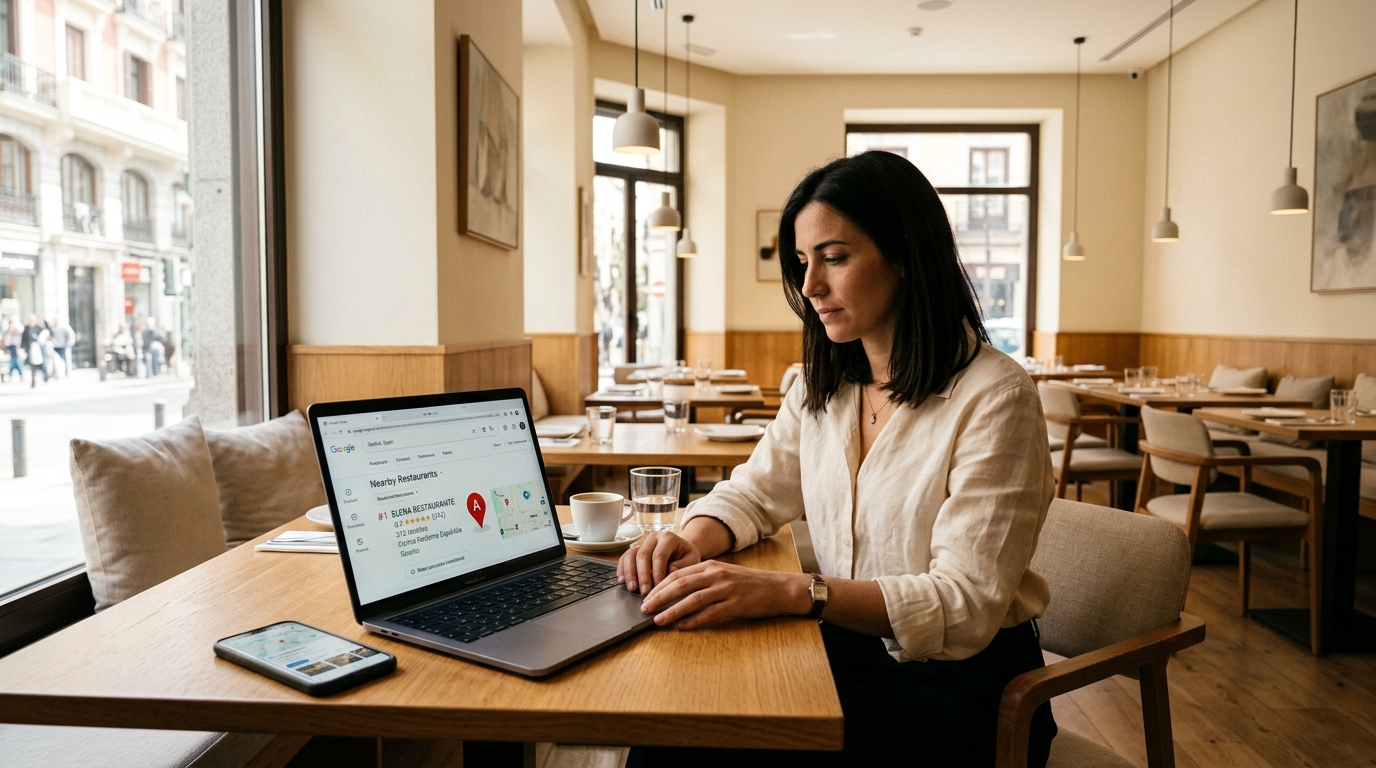
Local SEO for restaurants and hospitality: we work on your Google listing, Google Maps and your website from 350 €/month...
See the service →
Local SEO for hotels
Increase your hotel's direct bookings with local SEO. Reduce your dependence on OTAs and rank on Google for local search...
See the service →
SEO for food shops
Rank your gourmet shop, bakery workshop, wine shop or specialist food store on Google. Local SEO for food businesses....
See the service →Interested in gastronomic copywriting?
Book the Local SEO Audit Pro (290 €) and we prepare a proposal for your business. It is credited in full if you hire the GastroSEO plan within 30 days.