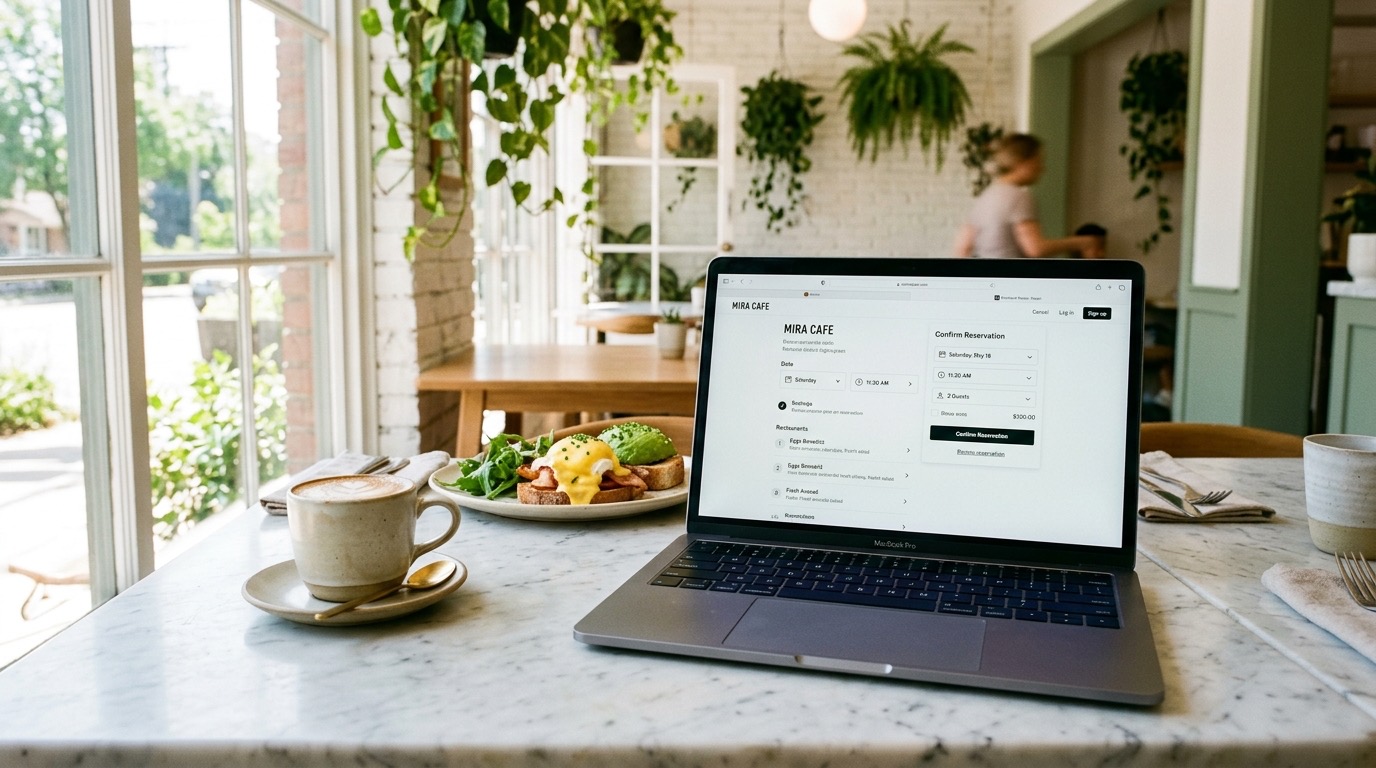
A successful restaurant website is the one that works as the centre of a system for attraction, conversion and local projection, not as a digital brochure. Its success is measured in customers who arrive, book, call, order and come back. We summarise that system in three layers: foundations, conversion and projection. With 234.900 food and drink service companies spread across 270.205 premises (INE, DIRCE, 1 January 2025), a restaurant does not compete against all of them: it competes against the ones that are visible in its neighbourhood, its city and its type of food.
What a successful restaurant website is (and its three layers)
A successful restaurant website is an asset that turns visits into customers and feeds the business’s visibility on Google Maps, social networks, platforms and AI assistants. It works as a system with three layers: foundations, what the customer sees and understands inside the website; conversion, what the customer does; and local projection, how the website goes out to find customers. All three are measured, and the whole system suffers if one is neglected.
If you only want the list of elements, it is in what a restaurant website should include; here you will understand the why and the full system, so you know what to commission and what to demand.
| Layer | What it includes | What is measured | Typical mistake |
|---|---|---|---|
| Foundations, what happens inside the website | Clarity at a glance, a readable menu, speed and mobile, real photography, copy that sells, structured data, legal pages | Load time, menu readability, bounce, internal clicks | A pretty website that is not understood at first glance, or a menu that exists only as a PDF |
| Conversion, what the customer does | Direct bookings, a call, WhatsApp, orders, vouchers, signals, monthly measurement | Bookings, calls, clicks to WhatsApp, routes to Maps, orders, conversion rate | Measuring only visits, or depending on platforms without capturing the data |
| Local projection, outside the website | Google listing, reviews, directories, local press, social and advertising, GEO, local pages | Positions on Maps and in the Local Pack, clicks to the website from the listing, review volume and replies, mentions in AI | An isolated website with no listing connected, or reviews left unanswered |
The difference between a digital brochure and a website that works is that the brochure shows and the website does. In the sections that follow you will see what each layer does, with concrete examples by type of business.
Layer 1. The foundations: what has to happen inside the website
There are no tricks here: if the website is not understood, does not load or does not invite action, it does not matter how much you invest in advertising. The foundations are built on a simple idea: the customer arrives in a hurry, from a phone, with a specific need.
The three seconds: who you are, where you are, how to book
When someone lands, the first thing they see has to answer three questions: what kind of place you are, where you are and how to book or order. There is no time for animations or empty welcome lines.
Imagine a tapas bar with a terrace. At the top it should say something like “Tapas and vermouth in [neighbourhood]”, together with the street and a visible “Book a table” button. Not “Welcome to our website”. If you are a neighbourhood restaurant with a short menu, the first screen should include the offer, the address and the booking or call button.
A hotel with a restaurant open to the public has a nuance: the visitor may be a guest or a neighbour. The website should make clear straight away whether you can come for dinner without staying, and whether there are separate hours. Google appreciates that clarity too, because it understands better what you offer.
The menu as a page, not as a PDF
A menu in PDF is convenient for the restaurant and terrible for the customer looking at a phone. They have to zoom, download a file, they cannot copy a dish name to search for it and, although Google indexes the PDF, it cannot read the menu as structured data or show it as a page of yours.
A menu as a page is readable on any screen, it is updated without uploading files and it lets you link each dish or each section from the local pages. The comparison of a free plan, a menu on your own domain and a platform is in the guide to a QR digital menu for restaurants. A workshop that sells to order, for example, can present its products and prices as pages it can then rank for “roscón de Reyes to order in [neighbourhood]”. If you want to see real examples, they are in examples of restaurant websites in Spain.
Speed and mobile: the thresholds Google evaluates
Google considers three Core Web Vitals values “good”: LCP, load of the main element, of 2,5 seconds or less; INP, response to interaction, of 200 milliseconds or less; and CLS, visual stability, of 0,1 or less (Google developer documentation, web.dev, consulted on 12 September 2026). Translated to the street: if the page is slow to show the menu, or the booking button jumps just as you are about to tap it, the customer leaves.
Speed is not only technical. It is design, image weight, hosting and the number of widgets. A website loaded with banners, a third-party chat and animations has a harder time meeting the thresholds. And on a phone with an ordinary connection, those fractions of a second cost bookings.
Real photography and copy that sells
Stock photos are obvious, and they take credibility away from everything else. You do not need a session with a professional photographer from day one, but you do need real photographs of the dishes, the room and the terrace in their normal state. A photo of a croquette cut in half, taken in good light next to the bar, sells more than a stock image. Photography is not included in any website plan: we work with your material and, if you do not have it, we tell you exactly what is needed.
The copy matters too. Describing a dish with precision and without empty adjectives — “torrija caramelizada con helado de leche merengada” — helps someone choose. If you need to shape the menu copy and the home page, gastronomic copywriting is exactly for that.
Structured data: so Google and AI understand what you are
Structured data is code that tells Google, and AI assistants, that you are a restaurant, where you are, what kind of food you cook, what your hours are and what you serve. There are markup types (schema) such as Restaurant, Menu or LocalBusiness designed for hospitality. They do not guarantee a rich result, because Google decides when to show it, but they do make sure the machine reads your hours, your address and your menu properly.
If a customer searches for “Japanese restaurant in [neighbourhood]”, a website with structured data makes it easy for Google to understand what you are, where you are and what time you open. It is not magic; it is information that helps the machine read your website correctly. And every time you change the menu, those data have to be updated too, so you do not show dishes that no longer exist.
Layer 2. Conversion: from the visit to the booking, the call or the order
The foundations do their job when the customer acts. This layer is what separates a website that brings customers from a website that only looks nice. Every possible action should have its own button and its own measurement.
Each action, a button and a measurement
Booking, calling, writing on WhatsApp, ordering for collection, buying a voucher or getting to the venue are different actions. They should not be hidden behind a single “contact” link. Each one deserves a clear button, reachable from any point on the website.
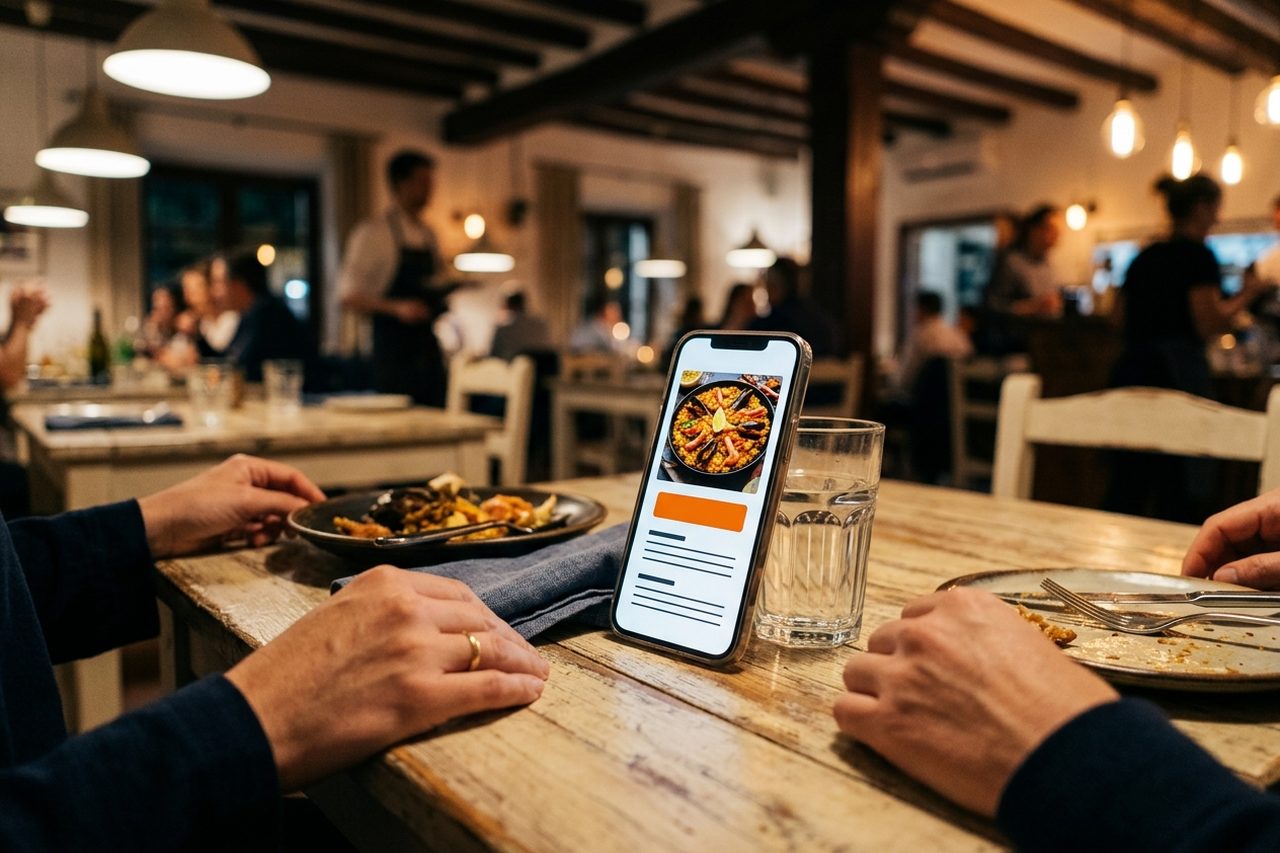
What you see on screen can be: a fixed “Book a table” button, another for “Call the restaurant” and another for “Order to take away”. What happens behind that is measuring how many times each one is tapped. Without that data, you will not know what is failing.
Direct bookings versus commission platforms
Booking platforms bring customers, but they charge for it and they keep the relationship: the diner’s history, the reminder and the next recommendation live in their app, not in your house. TheFork does not publish official rates; third-party sources consulted on 12 September 2026 (Bouzon Digital, EatsQR) place the visibility fee between 100 and 350 € a month and the commission between 1,50 and 4 € per guest, depending on the city and the plan. With margins that are tightening, every commission weighs.
According to the Anuario 2025 de Hostelería de España, presented on 16 December 2025 (reported by Hostelería Digital and Hosteltur), food-service turnover rose 3,1 % through September 2025 compared with the previous year, but profitability fell 0,9 %; the year-end left a turnover increase of between 2 and 4 % and an average of 1,89 million workers. In that setting, every euro that leaks away in commission or in a lost booking is harder to make up.
Your own website is the only channel you control: the domain, the direct booking and the customer’s data are yours. That does not mean closing the platforms. It means using them as a tributary. The customer who discovers you on TheFork can come back through your website, and that repeat visit pays no commission. What CoverManager, TheFork, Reserve with Google and your own form publish — price, commission and data — is in online bookings for restaurants.
WhatsApp and the phone: the invisible conversion
Not every conversion is a booking. There are customers who prefer to call to book a large table, or to ask on WhatsApp whether there is room for a group with children. That conversion is real, and you do not see it if you only look at the booking engine.
A phone button and a WhatsApp button with a visible number on mobile capture that intent. If the waiter then writes the booking in the house book, the website has still done its job. Measurement comes from a click on the button: you know how many people tapped “Call” or “WhatsApp” from the website, even if the conversation happens elsewhere.
Booking deposits, vouchers and orders: when to take payment on the site
Taking payment on the website is not always necessary, but there are cases where it is. A gastronomic restaurant with a tasting menu and limited tables reduces no-shows with a card deposit. A workshop that prepares to order can charge for the full product before making it. A hotel can sell lunch vouchers or Christmas dinner vouchers. How to sell that voucher or a tasting menu from the website is in restaurant gift vouchers.
All of this sits inside what the guide to a payment gateway for restaurants covers: when it makes sense to charge, how it is set up and what it means for the customer. The point is not to charge by default in every restaurant. It is to identify the services that justify it.
What to measure each month
In our experience, the metrics that really matter in a restaurant are: direct bookings from the website, calls and clicks to WhatsApp, direction requests on Google Maps, online orders, vouchers sold and the conversion rate against visits. You do not need a complex dashboard: a spreadsheet is enough at the start.
The conversion rate is calculated by dividing completed actions by visits to the website. If you do not know how many visits you have or how many direct bookings, you cannot know whether the problem is attraction or friction at the point of booking. Measuring each month tells you which layer to improve.
Layer 3. Projection: how the website goes out to find customers in its local niche
A good website that sits on its own is useless. Local projection is the layer that connects the website with the neighbourhood, the city, the reviews, the directories and the AI assistants. The website feeds all of this, and all of this sends customers back to the website.
| Channel | What it is for | What it needs from the website | Cost and who controls the data |
|---|---|---|---|
| Google listing and Google Maps | Appearing in local searches and showing hours, photos, reviews and bookings | Name, address and phone consistent with the listing, and a clear bookings page | Monthly management time; the customer’s data is yours if they book through your website |
| Organic search (local SEO and pages by neighbourhood or type of food) | Capturing neighbourhood or cuisine demand without depending on advertising | Pages by neighbourhood or type of food, structured data and speed on mobile | Recurring or one-off SEO work; the customer’s data is yours |
| AI assistants (ChatGPT, Gemini, Perplexity) | Appearing in conversational restaurant recommendations when people ask by area or cuisine | Clear content, structured data, a stable URL and consistent listings so you can be cited | Time spent optimising content; the customer’s data is yours if they reach your website |
| Social networks (Instagram, TikTok, Facebook) | Creating desire, community and traffic to bookings or the website from visual content | A clear bookings page and a stable URL to link from the bio | Time spent creating and managing each month; the data stays on the social network unless they book on your website |
| Paid advertising (Google Ads, Meta Ads, ChatGPT Ads) | Sending immediate traffic to bookings or promotions, segmented by area and intent | A landing page per campaign and a clear bookings page | Spend in the restaurant’s own accounts plus management; the data is yours if they land on your website |
| Booking platforms (TheFork and similar) | Adding visibility and bookings from their marketplace in exchange for a commission | Basic data consistent with the listing, and the menu as a page | Fee and commission per guest (according to third parties, from 1,50 to 4 €); the data belongs to the platform |
| Local press, guides and directories | Adding authority, mentions and links from media and guides in the area | A stable URL to link to, and an accessible menu or press note | Time spent on relationships and management; the customer’s data is yours if the recommendation leads to your website |
The Google listing and Google Maps, the shop window people look at most
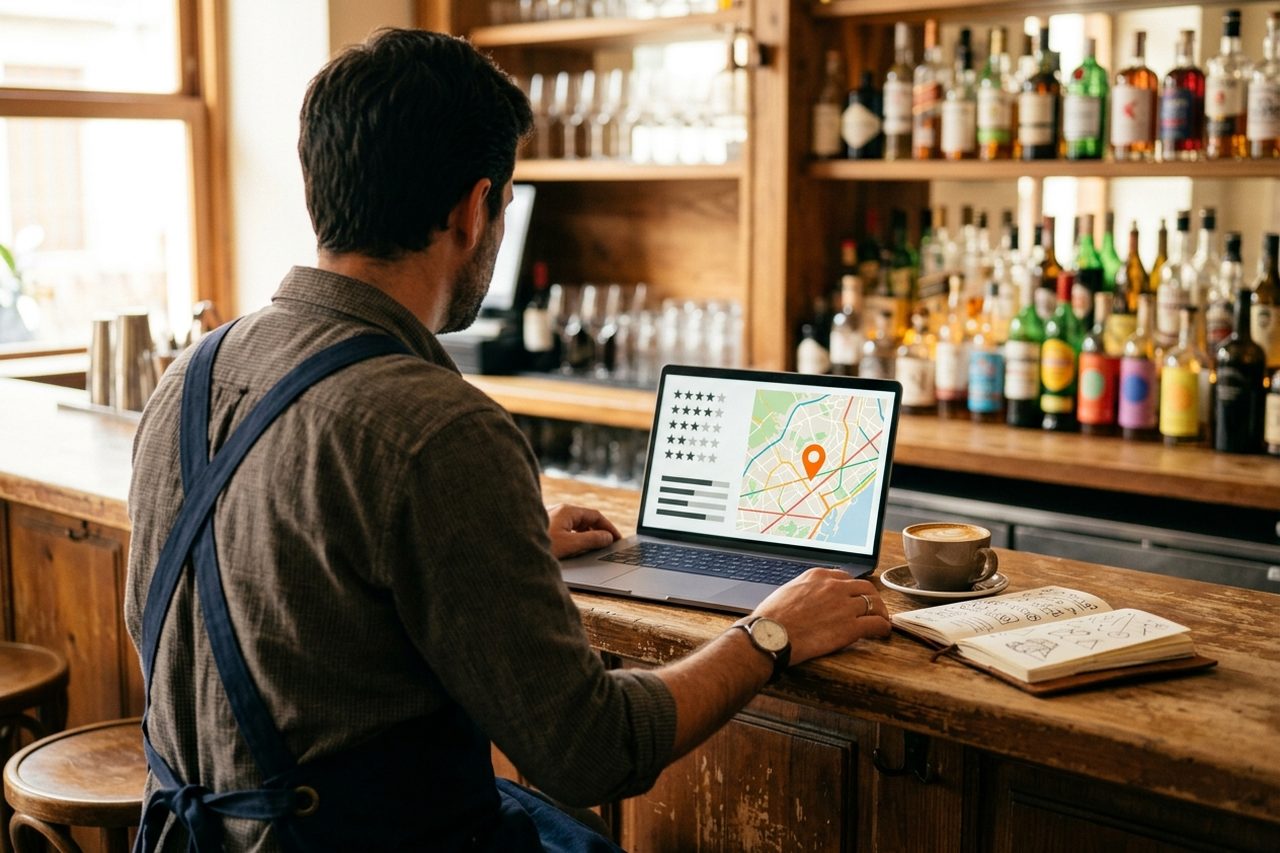
When someone searches for “restaurant for dinner near X”, the first thing they see is not a website: it is Google Maps with several listings. That Google Business Profile listing shows the name, the address, the hours, the photos, the reviews and a link to your website.
If the listing is incomplete or disconnected from the website, you are losing visibility at the exact moment of the decision. Keeping it up to date is continuous work, and that is why monthly management of the Google listing exists. The listing should match the website in name, address and phone, and it should link to the right page, not to the home page by default if a bookings or menu page is the better destination. The guide to ranking a restaurant on Google Maps explains it step by step.
Reviews: ask for them, reply to them and bring them onto the site
Reviews are not only social proof: they are a signal that Google and AI assistants read to decide whether your venue is relevant. This is not about buying reviews or asking for them aggressively; a reminder at the end of the meal, a QR code on the receipt or a message the next day to someone who left their contact and agreed to hear from you is enough.
Replying matters too. A calm reply, that uses the customer’s name and mentions the dish they talk about, communicates professionalism. And the best reviews can be brought onto the website as excerpts or a widget, so the social proof closes the conversion. We develop this in the guide to online reviews for restaurants.
Directories, press and local guides
Appearing in local directories, food guides or neighbourhood press strengthens two things: authority and links to your website. Think of the hospitality association in your area, the council’s cultural diary, your city’s tapas guide, the food blog the whole neighbourhood reads or the magazine of the festival where you are taking a stall. It does not replace local SEO, but it accompanies it. A feature in a local outlet or a mention in a tapas guide can send visits to your website and, above all, make Google see consistency between what your listing, your website and other sites say.
For that work to function, the website needs a unique, up-to-date URL. If a medium links to a home page from five years ago with the old menu, it loses value for you and for the reader.
Social and advertising as tributaries, the website as the destination
Instagram, TikTok or Facebook show the dish, the atmosphere and what is new. They are shop windows for inspiration. But if the conversation stays in direct messages and there is no website and no measurable booking, the effort dilutes.
Paid advertising works the same way: Google Ads, Meta Ads or ChatGPT Ads can send traffic with intent, but the landing has to be a clear page with a booking or order button. If you pay to send someone to a website that does not convert, advertising does not fix the problem; it amplifies it. Paid advertising for restaurants makes sense as an accelerator, not as a substitute for the foundations.
Showing up in ChatGPT, Gemini and Perplexity: GEO for restaurants
There are already customers who ask ChatGPT, Gemini or Perplexity directly: “where to eat dinner in [city]”, “a quiet restaurant for a work dinner in [neighbourhood]”. The assistants do not read your website in isolation: they answer from what they find indexed about you (your website, your listing as picked up by directories, the reviews and the guides that mention you). The more consistent all of that is, the better your chances of being cited.
The work of GEO for restaurants consists of preparing that information so the machines understand it and consider it relevant. It is an extension of local SEO, not an independent channel. If you want to go further, visit the GEO for restaurants page.
Pages by neighbourhood, city and type of food
The local niche is not only “restaurant in Madrid”. It is “a fish restaurant in the Salamanca neighbourhood”, “brunch in Ruzafa”, “a menú del día for work lunches in the centre”. Each of those needs deserves its own page if you have something real to offer.
These pages talk about their neighbourhood, their moment and their offer, without repeating generic text. It is the same logic we use for SEO by type of business and for local SEO city by city. For example, a beer bar with a terrace on a specific square can explain whether there is shade, whether dogs are welcome or whether it serves lunch until late. That does not only help the customer. It also gives Google and AI assistants concrete clues for showing you in local searches.
How it all fits: the full loop, step by step
Take a concrete case: a couple wants to eat dinner on a Saturday in their city. They search on their phone for “restaurant for dinner near [neighbourhood]”. Google Maps shows several listings; one of them has good photos, recent reviews and a link to the website.
They enter the website. In three seconds they understand what the food is, where it is and they see a “Book a table” button. They look at the menu as a page, they choose, they book with automatic confirmation and, when the time comes, they arrive at the venue. The next day they receive a message asking for a review. They leave it because dinner was good. Google strengthens the listing and, weeks later, another person making a similar search sees that review and repeats the loop.
At each step, the restaurant did something concrete: keep the listing up to date, reply to reviews, have a fast website with direct booking, confirm instantly and ask for the review naturally. It is not a campaign: it is a system that feeds itself, and that is sustained by constant work rather than by bursts of advertising.
The mistakes that break the system even when the website “looks fine”
- A website with no listing connected, or a listing with no website. They are two doors in; if only one works, you lose half the journey.
- Bookings only through a platform. Customers arrive, but the relationship and the repeat visit stay on the platform, not with you.
- An out-of-date menu. A dish that no longer exists causes frustration and a bad impression that lasts longer than any good photo.
- Ignoring reviews, or replying badly. A negative review with no reply speaks for itself; a positive review with no reply wastes a relationship.
- Measuring nothing. Without monthly metrics, any change is an opinion, not a decision.
- Generic copy that would fit any restaurant. If you say “market cooking with fresh produce” you are saying nothing; say which dishes, from which market and for which moment.
- No local pages and no pages by type of food. If you do not talk about your neighbourhood or your speciality, you leave others to do it for you.
Where to start, depending on your situation
Not everyone starts from the same point. What matters is that the first step does not leave you stuck, and that each investment answers the problem you already have.
I do not have a website
If you do not have a website and your venue runs on the phone or on social networks, start with a one-page website with the foundations clear: the offer, the address, a readable menu, a booking or call button. Then add the measurement layer and the Google listing. You can see the options on the web design for restaurants page, with fixed plans from 890 €, one-off payment, the first year of domain and hosting included; the booking system comes in from the 1.490 € plan.
I have a website but bookings do not come in
Here there are almost always two possibilities: either the website does not convert because of friction (unclear buttons, a menu in PDF, slowness) or local traffic does not arrive because the listing and neighbourhood SEO are not working. First measure what is happening: how many visits? how many actions? If the visits exist but do not convert, it is foundations and conversion. If there are no visits, it is local projection.
At this point, the Local SEO Audit Pro (290 €, on our services and prices page) or the GastroSEO Basic local SEO plan at 350 € a month with no lock-in are there to put the priorities in order. They are not the same thing: the audit diagnoses; the plan executes month by month.
I depend on platforms and commissions
If your diners arrive mostly through TheFork or through delivery apps, do not break with the platforms all at once. First enable direct booking on the website, ask for the review yourself and capture the contact on the visits you do control. Later, when the website converts, you can decide how much visibility you buy and on which platforms. The commission, according to third parties, runs from 1,50 to 4 € per guest: multiply it by the guests who reach you through a platform and you will have the order of magnitude of what you pay today for not having your own channel.
You will find the cost detail in the guide to how much a restaurant website costs, which walks through market ranges and the agency’s fixed plans.
I am opening a new venue
If you have not opened yet, you have an advantage: you can launch the website and the listing at the same time, with a “coming soon” page that starts to build expectation. From day one, work on the pages by neighbourhood and type of food, invite the first diners (the preview ones, or the ones from the first week) to leave their review, and have the digital menu ready. Do not wait until you open to start appearing on Google. For an opening, the fixed-price packs combine website, Google listing and local SEO in a single commission.
In short: a system, not a brochure
A successful restaurant website does not exist by chance. A system exists that is understood, measured and adjusted: clear foundations, conversion without friction and constant local projection. If one of the three layers fails, the other two do not compensate; if all three work, the restaurant stops chasing customers and starts collecting them.
At GastroSEO this is what we do. If you want to talk about your case, with no obligation, you can look at the web design for restaurants and hospitality plans and write to us with what you have. We do not sell a magic formula; we tell you where to start and what comes first.
Frequently asked questions
What makes a restaurant’s website successful?
That it works as the centre of a system and not as a brochure. It has to be understood at a glance, without scrolling or explanations, load quickly on a phone, show a readable menu, offer clear buttons for booking, calling or WhatsApp, and be connected to the Google listing, the reviews and the AI assistants. You also have to measure each month how many visits turn into real customers. If it is not measured, any change is only an opinion.
What matters more on a restaurant website: the design or the bookings?
The bookings. A pretty design that does not convert is an expensive shop window. A simple, clean, clear design with a visible booking button, a readable menu and the right speed will do more for the business. Design matters for building trust and conveying the character of the place, but it is at the service of the action. First you define what the customer should do, and then you design so they can do it without friction.
Is it better to have your own website or to depend on TheFork, Instagram and delivery apps?
It is not one or the other. Your own website is the only channel you control: your domain, your data, with no commissions. TheFork, delivery and social networks are tributaries that bring customers, but they charge a commission or they keep the relationship. The healthy strategy is to use the tributaries to capture and to lead people to the website; that way, the customer who comes back can do it direct, with no commission, and the restaurant keeps the relationship.
How do I get people to book from my website instead of calling or writing on Instagram?
Make every route easy, but make the direct booking the most visible and the fastest. A fixed “Book a table” button, a short form, automatic confirmation and, where it applies, a card deposit. On social networks, do not reply only by message: link the website in the bio and in every post. If the customer sees that the website is faster and more reliable than waiting for an Instagram reply, they will choose the website.
How do I get my restaurant onto Google Maps and into searches for my neighbourhood?
Complete and verify your Google Business Profile listing with name, address, phone, hours, real photos and the right category. Connect it to your website and keep what both say consistent. Create specific pages by neighbourhood and type of food, ask for reviews naturally and reply to them. All of that sends local relevance signals to Google, and it is work that is maintained month by month, not a setup you do once.
Does the website help ChatGPT or Gemini recommend my restaurant?
Yes. ChatGPT, Gemini and Perplexity read signals from Google listings, reviews, directories, content and structured data. A fast website, with correct structured data, an up-to-date menu and consistency with its local listing has a better chance of appearing when someone asks for recommendations. You cannot buy the recommendation, but you can prepare the ground: that is GEO for restaurants.
How much does a restaurant website that really works cost?
It depends on the scope. A basic project can start from 890 € on fixed web-design plans, with domain and hosting included for the first year; the booking system comes in from the 1.490 € plan. If monthly local SEO is added, management costs 350 € a month with no lock-in, and paid advertising, from 450 € a month of management. It is an investment, not an expense: the website has to return customers.
How often does a restaurant website need to be updated?
The menu and the hours should be updated whenever they change, even the same day if a dish is off the menu or there is a one-off closure. The photos, each season or when the room changes. The reviews, continuously. The structure, the copy and the local pages can be reviewed each quarter. An out-of-date website is worse than a bad website: it sells something that no longer exists.